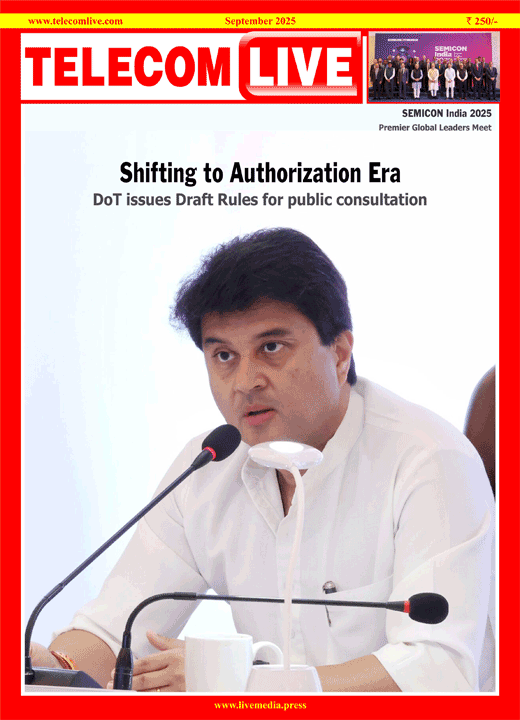
DoT to evaluate Trai views, decide on next spectrum sale timelines: Scindia

The Union Minister of Communications Jyotiraditya Scindia said on Wednesday that the Department of Telecommunications (DoT) would take a call on the next airwaves auction across multiple bands, following a review of the regulator’s recommendations.
“The TRAI (Telecom Regulatory Authority of India) has come out with its recommendations now. Based on those, the DoT will take a view. So, the recommendations will be evaluated, and based on that, the next spectrum auction will be decided,” Scindia told reporters.
Further, the minister said that TRAI recommended the spectrum volume across various horizontal bands, including reserve pricing, and added that a decision would follow a careful examination.
On Tuesday, the sector watchdog shared views on multiple frequency bands and suggested auctioning the entire available spectrum in the 600 MHz, 800 MHz, 900 MHz, 1800 MHz, 2100 MHz, 2300 MHz, 2500 MHz, 3300 MHz, and 26 GHz frequency bands in the upcoming auction.
The watchdog suggested putting the entire 11,790 MHz spectrum, valued at about ₹2.1 lakh crore, up for sale.
In the 2024 auction, the government raised ₹113 billion or about $1.30 billion, compared to the 2022 sale that raised ₹1.5 trillion (about $17 billion).
In the 2022 airwaves sale, Indian billionaire Mukesh Ambani-owned Reliance Jio emerged as the sole bidder for the coveted 700 MHz spectrum, securing 10 MHz across circles for about ₹393 billion.
It also proposed lower-entry barriers for new entrants and a uniform 35% spectrum cap across low-, mid-, and high-frequency bands, including 600 MHz, sub-1 GHz bands, 1800-2500 MHz bands, 3300 MHz, 26 GHz, and 37-40 GHz, to safeguard competition in the telecom space.
The regulator also said that in a scenario where a telecom carrier has already acquired spectrum and exceeds the 35% spectrum cap, it should not be asked to surrender the right to use any spectrum it already holds.
Following the unsold spectrum in the 2022 auction, the 600 MHz range contributes to nearly 62% of the overall spectrum availability with a reduced base price of up to 17%.
TRAI also advocated reserving the 6 GHz (upper) band for mobile telephony services and added that the available airwaves bands in the 6425-6725 MHz and 7025-7125 MHz should not be put up for sale. It also advised that the issue of auctioning the spectrum in the 6 GHz (upper) band should be re-examined after considering the outcome of WRC-27.
The telecom watchdog also recommended that the telecom department should “immediately initiate action for taking back the spectrum” held by telecom service operators engaged in the corporate insolvency resolution process under the Insolvency and Bankruptcy Code, 2016, and that such spectrum should be made available for the forthcoming spectrum auction.
TRAI also proposed a reduction of up to 10% in the spectrum cost from the auction-determined price for all licensed service areas (LSA) across frequency bands.
The DoT should re-examine the adoption of an appropriate band plan for the 1427-1518 MHz frequency range, it said, adding that the department should ensure contiguous availability of the 67 MHz block to the government user.
A recent global spectrum pricing finding indicates that telcos spent more than $174 billion for spectrum auctions since the beginning of 2021, with almost $140 billion raised in 2021 alone. The sale activity slowed sharply in 2022, with India becoming the only country to auction millimetre-wave spectrum.
In 2025, the activity declined sharply, with only $7.1 billion raised worldwide.