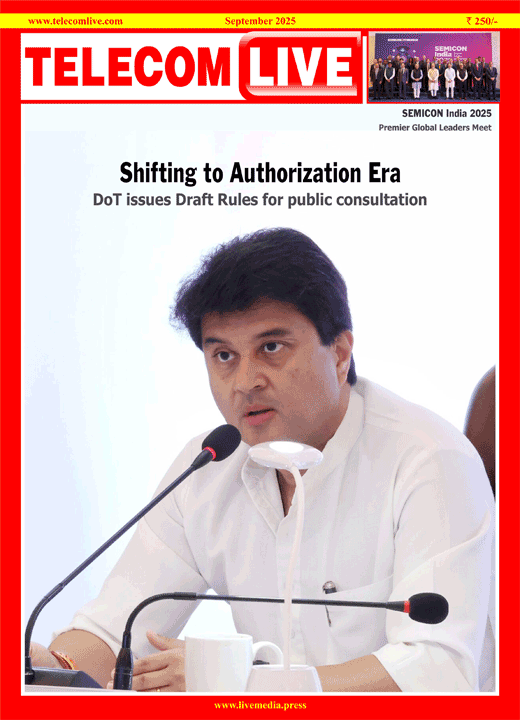
India seeks global consensus on AI, IP & copyright protection: Ashwini Vaishnaw

India is seeking to achieve a global consensus on ensuring that artificial intelligence (AI) does not infringe upon the copyrights of content creators, a top official of the Ministry of Electronics and IT (MeitY) said on Monday.
“Given that the challenges between AI and copyright are very complex, we are, during the India AI Impact Summit, looking at some sort of consensus on this. If the creators get a chance to deploy their skills, protect their copyrights, and the fruits of their creative energy, then the growth (of the creative industry) between today and tomorrow will be very high,” Ashwini Vaishnaw, union minister of electronics & IT, said.
The foundational models, including large language models (LLMs) and small language models (SLMs), are trained on knowledge that already exists, such as books, periodicals, and content sources, which maybe copyrighted.
Lately, this rapid proliferation of AI chatbots has been on a collision course with authors of copyrighted books, as well as news agencies and individuals, who allege that the AI companies are accessing copyrighted material in an unauthorised manner to develop models and enhance competitiveness in the market.
While the copyright infringement has led to class-action lawsuits, several entities, including news agencies, have entered into licensing deals with AI service providers as an interim measure.
“For a right balance between IP and innovation, would a simple regulation do that? Probably not,” Vaishnaw stated, while addressing a joint conference with Charles Rivkin, chairman & CEO, Motion Picture Association.
“That would require a lot of consensus-building. That would also require a lot of technological tools to be created. Our understanding so far is that for such complex problems, we have to have techno-legal solutions,” the minister said.
Techno-legal solutions, according to him, will address legal aspects while keeping technical guardrails in consideration, along with technical balancing features in AI models, as well as, in the way AI is deployed.
“We are very closely engaged with the industry to find out the right technical and legal structures for this. This will require a consensus-building across different countries.”
India’s Principal Scientific Advisor, Ajay Sood, also told ET in an interview recently that the Centre seeks to have a techno-legal framework for ensuring artificial intelligence or AI safety, following the success of the country’s digital public infrastructure (DPI).
“We believe that human creativity is the most important thing that we have in our entire civilisation. So we must protect it, we must make sure that any system which protects human creativity and enhances it is a better system,” Vaishnaw said. “AI should have a complementing effect on human creativity, job creation, and talent pipeline.”
Meanwhile, the Prime Minister Narendra Modi-led government has been bullish on developing a robust homegrown creator economy through various policy measures.
In the Union Budget for FY2026-27 announced earlier this month, the Centre has proposed establishing “AVGC (Animation, Visual Effects, Gaming, and Comics) Content Creator Labs” in 15,000 secondary schools and 500 colleges nationwide.
By embedding creative skills within the formal education system and expanding access across regions, the initiative aims to create a new generation of talent in line with projections that the AVGC sector will require nearly 2 million professionals by 2030.
“Throughout the country, we will be opening these content creator labs. We have partnerships with the entire industry, and like what we did in semiconductors, we have the world’s best tools available to the students in 315 universities,” the minister said.
Industry estimates show that India’s animation and visual effects sector is valued at nearly ₹10,300 crore, while the gaming sector is valued at about ₹23,200 crore.